From 8 to 10 September 2026, Bratislava, Slovakia, brought together Lean Six Sigma professionals, academics, consultants and business leaders from around the world for the International Lean Six Sigma Conference 2026.
Hosted by the Faculty of Management at Comenius University Bratislava and co-organised with the International Lean Six Sigma Institute (ILSSI), the conference welcomed more than 140 participants from 26 countries.
For three days, the focus were ways organisations can improve the way they work while dealing with new technologies, changing customer expectations and changing workplace cultures. The discussions covered Lean Six Sigma, operational excellence, process improvement, quality management, process management, digital transformation and artificial intelligence. Just as importantly, participants had the chance to discuss how these ideas work in real organisations.
Bringing the Lean Six Sigma Community Together
The International Lean Six Sigma Conference 2026 created a meeting point for people who work with improvement in different ways. The audience included managers, operational excellence professionals, process improvement specialists, Lean Six Sigma practitioners, consultants, researchers and academics. The conference also began with an informal welcome evening on 7 September. It gave international guests an opportunity to meet before the main programme started and set the tone for the days that followed.
The official opening was led by Prof. Mgr. Peter Štarchoň, PhD., Dean of the Faculty of Management at Comenius University Bratislava.
Lean Six Sigma in a Changing Business Environment
Lean Six Sigma remains closely connected to reducing waste, improving processes and solving problems using a structured approach. But the environment in which organisations apply these methods is changing.
Technology is changing how companies collect and use information and artificial intelligence is becoming part of everyday business discussions. Digital systems are changing how processes are managed, while workplace expectations and organisational cultures are also shifting. These changes were central to the International Lean Six Sigma Conference 2026.
The conference theme, “Lean Six Sigma in a world of Changing Technologies and culture”, gave speakers and participants room to discuss where traditional improvement methods fit into this changing environment. The question was not simply about adding new technology to existing processes but it was about understanding how technology, people and established improvement methods can work together.
That is an important discussion for anyone working in operational excellence.
One of the strengths of the conference was the connection between academic research and practical business experience. Lean Six Sigma is widely used in organisations, but research continues to shape how improvement methods are understood and applied. Bringing researchers, academics and practitioners into the same room creates an opportunity for both sides to learn from each other.
There were also practical sessions covering subjects such as process mapping, customer journey mapping, Design of Experiments, DMAIC, Lean 5.0, Training Within Industry and modern improvement technologies. For practitioners, this kind of programme provides something useful: an opportunity to look at familiar methods from a different perspective and consider how they can be applied to current business problems.
Artificial Intelligence and the Future of Process Improvement
Artificial intelligence (AI) was one of the subjects discussed during the conference. AI is already changing how organisations approach data, analysis and routine work. For Lean Six Sigma professionals, this raises practical questions about how these technologies can support established improvement methods.
Where can AI help with data analysis?
How can digital tools support problem-solving?
What happens to improvement work when more information becomes available in real time?
And how should organisations balance technology with human knowledge and decision-making?
These questions are becoming increasingly relevant for operational excellence teams.
The conference provided a space for participants to discuss these issues alongside established Lean Six Sigma methods rather than treating technology as a separate subject.
Furthermore, the value of an international conference is not limited to presentations and workshops. The conference included several opportunities for participants to meet, exchange ideas and build professional relationships. A social evening at Moyzes Hall gave attendees another opportunity to connect outside the formal programme.
These conversations can be particularly useful in a field such as Lean Six Sigma, where professionals often deal with similar problems in very different industries.
A process improvement manager in manufacturing may face different operating conditions from someone working in healthcare, financial services or logistics, but the underlying questions can often be similar.
- What is causing the problem?
- Where is waste entering the process?
- How do we understand the current state?
- How do we involve people in the improvement?
- How do we know the change has worked?
Sharing experiences across industries can help professionals see these questions from a different angle.
The People Behind International Lean Six Sigma Conference 2026
A successful international conference requires a team working behind the scenes.
At the Faculty of Management at Comenius University Bratislava, the organisation was led primarily by Assoc. Prof. Mgr. Peter Madzík, PhD., Assoc. Prof. PhDr. Lukáš Copuš, PhD., and Prof. Ing. Ján Papula, PhD., with contributions from other members of the university team.
The conference also brought together ILSSI representatives and partners, including John Dennis, John Rooney and Juliane Haan.
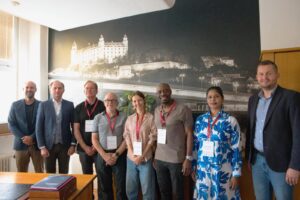
L-R: Peter Madzík, Peter Štarchoň, John Dennis, John Rooney, Juliane Haan, Kola Olutimehin, Anita Stalin and Lukáš Copuš.
Their involvement reflects the international cooperation behind the event and the shared interest in developing Lean Six Sigma and operational excellence.
For ILSSI, the conference was also an opportunity to continue building connections within the international Lean Six Sigma community and support conversations about the future of continuous improvement.
Organisations will keep looking for better processes, lower waste, stronger quality and more reliable ways of working. Lean Six Sigma will continue to provide a structured way to approach those challenges, while new technologies will create new questions about how improvement should be done. That conversation is only beginning. If you work in Lean Six Sigma, operational excellence, quality management or process improvement, ILSSI provides professional certification, training and learning opportunities for people looking to develop their improvement skills.
Explore ILSSI and learn more about Lean Six Sigma certification and professional development.






















![UCOURSE.ORG [UCOURSE Academy] was established in Hong Kong in 2019 (company name: UCOURSE LTD), dedicated to providing high-quality online courses and courses for Chinese people in China, Hong Kong, and even all over the world. UCOURSE.ORG 【优思学院】于2019年成立于香港(公司名称:优思学院有限公司 / UCOURSE LTD),致力于为中国、香港、以至身处于全球各地的中国人提供优质的线上课程和考试认证,促进全国的人材培育、个人的职业发展,让学员在事业上事半功倍,同时助力国家的未来的急促发展。](https://ilssi.org/wp-content/uploads/2021/02/ucourse-logo-250.png)